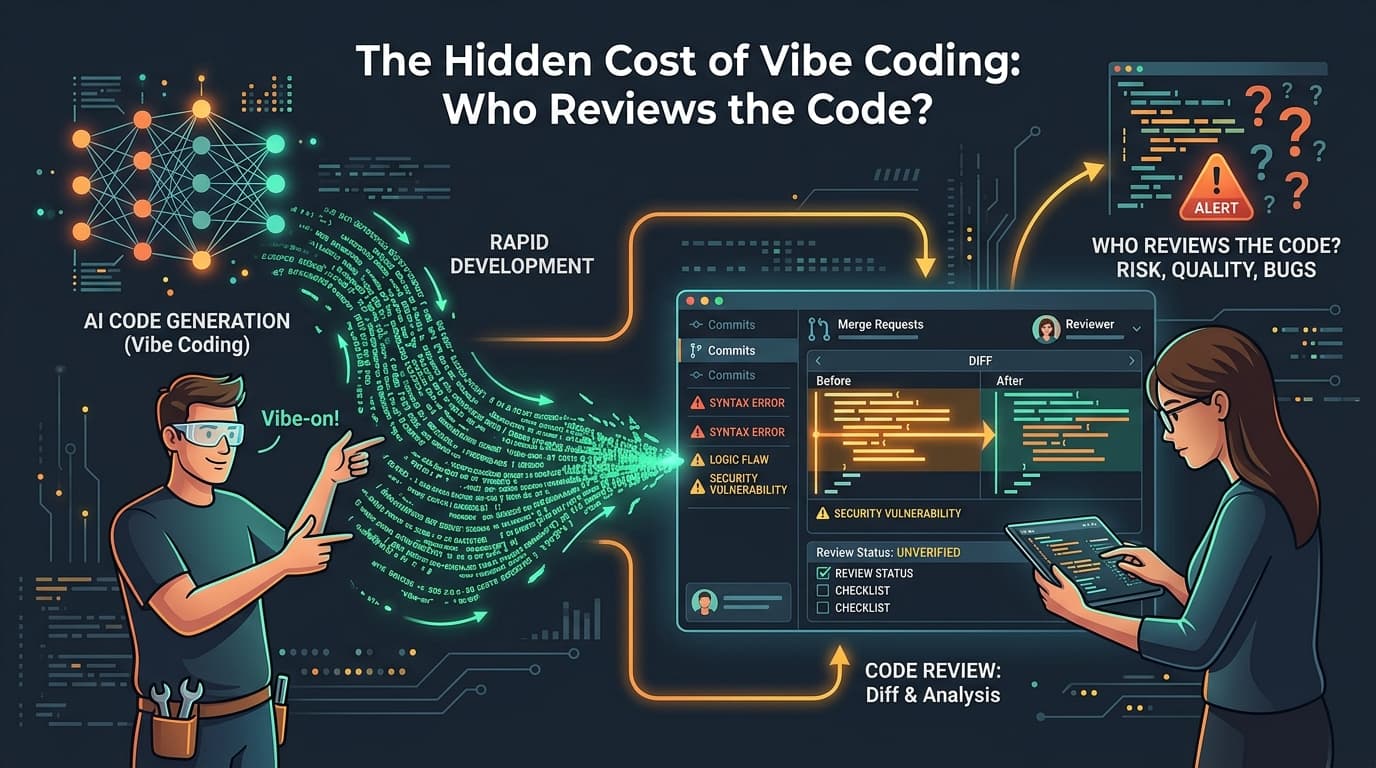
The Hidden Cost of Vibe Coding: Who Reviews the Code?
AI can write your code in seconds. But who is responsible when that code is wrong? A research-backed breakdown of vibe coding, verification bottlenecks, security risks, and software trust.
Inside this guide
- What Exactly Is Vibe Coding?
- The Vibe Coding Promise
- The Productivity Illusion
- The AI Coding Paradox
- What the Numbers Are Telling Us
- The Code Review Bottleneck
- The Real Cost of Vibe Coding
- Vibe Coding vs. AI-Assisted Engineering
- Where Vibe Coding Makes Sense (and Where to Slow Down)
- The Most Dangerous Sentence in AI Development
- The New Role of the Developer: Verification & Judgment
- AI as a Junior Developer With Superpowers
- The Vibe Coding Safety Loop & What Developers Should Review
- A Simple Rule for AI-Generated Code & The Six-Month Test
- The Hidden Cost Isn't AI: Unverified Complexity
- The Future Isn't "AI vs Developers"
- So, Should You Vibe Code?
- The New Golden Rule
- Final Thought
- Sources & Further Reading
There is something strangely addictive about building software with AI.
You describe what you want. The AI writes the code. You run it. It works. You ask for another feature. It writes more code.
A few minutes later, something that could have taken hours — or even days — appears on your screen. You start thinking:
“Why was I writing all this code manually before?”
And that is exactly where the interesting part begins.
Writing software has never been only about producing code. It has always been about understanding the code, testing it, securing it, maintaining it, and taking ultimate responsibility for what happens after it reaches users.
AI has made code generation dramatically easier. But it has created a critical new bottleneck:
Who reviews all the code that AI is generating?
Welcome to the hidden cost of vibe coding.
What Exactly Is Vibe Coding?
The term vibe coding gained widespread popularity in early 2025 after AI researcher and programmer Andrej Karpathy described a style of development where the programmer largely lets an AI model generate and modify the codebase, sometimes without deeply reading or auditing the underlying implementation.
However, an important distinction is often lost in current industry discussions:
Using AI to write code is not automatically vibe coding.
The defining characteristic of vibe coding is the level of human understanding, critical evaluation, and code review.
                 HUMAN INVOLVEMENT

High                                             Low
 │                                                │
 ▼                                                ▼

Traditional     AI-Assisted       AI-Driven       Vibe
Coding          Engineering       Development     Coding

Write code      AI writes         AI handles      AI writes
manually        boilerplate       large parts     almost everything

Review          Review            Review          Minimal review

Understand      Understand        Understand      “It works,
everything      important parts   architecture    so ship it”
The Vibe Coding Promise
Vibe coding — and AI-assisted development more broadly — offers something developers have wanted for decades:
Less friction between an idea and working software.
Imagine giving your AI assistant a single natural language instruction:
“Build a Flutter expense tracker with categories, monthly spending charts, local storage, dark mode, and CSV export.”
Instead of spending days manually creating screens, data models, state repositories, database schemas, validation functions, navigation routes, widgets, and services, an AI coding tool can generate a massive portion of the application in seconds.
The loop shifts from manual engineering to rapid iteration:
IDEA ➔ PROMPT ➔ AI GENERATES CODE ➔ RUN ➔ “LOOKS GOOD” ➔ ADD FEATURE ➔ AI GENERATES MORE ➔ RUN AGAIN
The adoption data reflects this massive shift:
- GitHub's Octoverse Report logged over 1.1 million public repositories using LLM SDKs, with 80% of new GitHub developers activating Copilot within their first week. GitHub also cataloged over 4.3 million AI-related repositories.
- Stack Overflow's Developer Survey revealed that 84% of respondents were using or planning to use AI tools in development, while 51% of professional developers used AI coding tools daily.
AI-assisted software development is no longer an experimental niche — it is standard engineering practice.
The fundamental question is no longer "Will developers use AI?" The crucial question for modern software engineering is:
“How do developers leverage AI without losing control of their software?”
The Productivity Illusion
Suppose a developer previously required 8 hours to write a feature from scratch. With an AI coding agent, the initial code implementation takes only 1 hour.
On the surface, that looks like an 8x productivity explosion. But what happens across the entire production software lifecycle?
TRADITIONAL WORKFLOW:
8 hours coding ➔ 1 hour testing ➔ 1 hour review = TOTAL 10 HOURS

AI-ASSISTED PRODUCTION WORKFLOW:
1 hour generation ➔ 2 hours understanding ➔ 2 hours debugging ➔ 2 hours reviewing ➔ 1 hour security/testing = TOTAL 8 HOURS
Note: The figures above illustrate realistic lifecycle distribution rather than a rigid benchmark.
Generating code faster does not automatically mean delivering reliable, maintainable software faster.
Stack Overflow's survey revealed that 46% of developers distrust the accuracy of AI output, compared to only 33% who trust it.
Even more telling:
- 66% of developers reported that their biggest frustration was AI solutions that were "almost right, but not quite."
- 45% of developers noted that debugging AI-generated code can take significantly more time than debugging code they wrote themselves.
The AI Coding Paradox
As AI tools remove the friction of generating code, they amplify the downstream burden on software verification:
AI MAKES CODE GENERATION FASTER
               │
               ▼
      MORE CODE CREATED
               │
               ▼
     MORE CODE TO REVIEW
               │
               ▼
   MORE CODE TO UNDERSTAND
               │
               ▼
     MORE CODE TO MAINTAIN
               │
               ▼
 REVIEW BECOMES THE BOTTLENECK
This represents one of the defining engineering challenges of the AI era:
The primary bottleneck in modern software development is no longer code generation — it is code verification.
What the Numbers Are Telling Us
AI Adoption vs. Output Trust
The Code Review Bottleneck
Research from Qodo on AI-generated code quality highlights a growing delivery challenge in enterprise teams: developers are utilizing AI across generation, refactoring, test suites, bug fixes, and documentation, but review and validation have emerged as primary velocity blocks.
Qodo describes this phenomenon as the growing "Trust Tax" of AI engineering.
AI doesn't just produce code — it produces a vast volume of logic that humans must audit, verify, and maintain. And human comprehension does not scale at the speed of LLM token generation.
The Real Cost of Vibe Coding
Relying on unverified AI code introduces five hidden "taxes" that compound over time:
1. The Understanding Tax (Understanding Debt)
If an AI generates 2,000 lines of code that compile cleanly and pass initial checks, but nobody on the team understands why specific architectural choices, queries, or permissions were selected, you have accumulated understanding debt.
Six months later, when a subtle edge case occurs in production, understanding debt instantly converts into expensive technical debt.
2. The Debugging Tax
AI models excel at resolving syntax errors and surface-level bugs. However, complex software failures are rarely surface-level.
Consider a payment gateway scenario:
User Taps "Pay" ➔ API Request ➔ Payment Provider ➔ Network Timeout ➔ Payment Succeeds on Gateway ➔ App Reports Failure ➔ User Taps "Pay" Again
An AI agent might patch the visible UI error by adding a generic error handler. But the underlying issue requires deep architectural understanding of idempotency keys, transaction locks, and distributed state.
3. The Security Tax
AI models are trained on vast repositories of public code, which inevitably include legacy patterns and insecure practices.
OWASP's Secure Coding with AI Guidance explicitly warns that AI coding agents operating with broad environment access can introduce critical security risks, including insecure authentication flows, missing rate limiters, unvalidated input parsing, and loose CORS configurations.
4. The Dependency Problem
AI tools frequently import third-party packages to solve specific tasks. Without strict human review, this introduces risks such as:
- Typosquatting / hallucinated package names
- Unmaintained or abandoned dependencies
- Over-privileged permissions
- Known CVE security vulnerabilities
Never confuse "the code compiled" with "the dependency is secure and trustworthy."
5. The Architecture Tax
Software architecture is the art of deciding which solutions should exist in the first place, how data flows between system boundaries, and how components fail gracefully under heavy load. AI can generate individual functions, but engineers must design resilient system boundaries.
Vibe Coding vs. AI-Assisted Engineering
| Dimension | Vibe Coding | AI-Assisted Engineering |
|---|---|---|
| Primary Goal | "Make it work quickly" | "Make it correct, secure, & maintainable" |
| Starting Point | Prompt-first | Architecture-first |
| Code Review | Accept output with minimal auditing | Thorough line-by-line diff review |
| Testing Philosophy | "Passing tests prove it works" | "Tests are evidence, not absolute proof" |
| Ownership | AI drives implementation | Engineer directs AI execution |
| Optimization | Optimized for initial speed | Optimized for long-term reliability |
| Context | Low comprehension of generated logic | High comprehension of critical paths |
Where Vibe Coding Makes Sense (and Where to Slow Down)
Vibe coding is not inherently bad — its suitability depends entirely on the cost of failure.
🟢 Ideal Use Cases for Vibe Coding:
- Rapid Prototyping — Validating product concepts quickly.
- Hackathons & Demos — Speed matters more than long-term maintainability.
- Throwaway Scripts & Internal Tools — Single-use utilities operated only by you.
- UI Layout Exploration — Rapidly testing visual variations.
- Boilerplate Generation — Generating repetitive data models or mock structures.
🔴 High-Risk Areas Requiring Rigorous Engineering & Review:
- Authentication & Authorization (OAuth, JWT, RBAC)
- Payment Processing & Financial Ledger Logic
- Healthcare Data & PII Storage (HIPAA/GDPR compliance)
- Cryptographic & Encryption Implementation
- Production Database Migrations & Schema Changes
- High-Scale Distributed Systems & Infrastructure as Code
The Most Dangerous Sentence in AI Development
The most dangerous assumption in modern AI-assisted engineering is:
“The tests are passing, so the code must be right.”
If an AI tool generates both the feature implementation and the unit test suite, it effectively checks its own work against its own assumptions.
UNGUARDED AI LOOP:
AI Writes Code ➔ AI Writes Tests ➔ AI Runs Tests ➔ All Pass ➔ Human Assumes System Is Correct
Without independent human validation, tests can simply re-verify the AI's initial hallucinations or miss critical security edge cases entirely.
The New Role of the Developer: Verification & Judgment
AI is not replacing software engineers — it is elevating their role from code typists to system architects, code reviewers, and security gatekeepers.
YESTERDAY:     Developer Writes Code ➔ Tests Code ➔ Deploys
TODAY:         Developer Directs AI ➔ Audits Code Diff ➔ Tests ➔ Deploys
TOMORROW:      Developer Designs Architecture ➔ Guides AI Agents ➔ Verifies Security & System Bounds ➔ Validates Behavior ➔ Approves Deployment
As AI makes code generation cheap and abundant, human verification, critical judgment, and system architecture become the most valuable skills in tech.
AI as a Junior Developer With Superpowers
Imagine hiring an incredibly fast junior developer.
They can:
- Write thousands of lines of code in seconds
- Know hundreds of syntax rules, libraries, and frameworks
- Generate test cases and explain technical documentation
- Refactor functions and create rapid prototypes
But occasionally, they:
- Misunderstand subtle project requirements
- Hallucinate non-existent API methods or dependencies
- Select unmaintained or insecure third-party packages
- Introduce subtle architectural logic bugs
- Confidently present incorrect answers as facts
Would you allow that developer to deploy directly to production without any human code review?
Probably not. So why should we treat AI coding agents differently?
AI is an extremely productive engineering assistant — not the owner of the software.
The Vibe Coding Safety Loop & What Developers Should Review
To ship production-ready software with AI agents, follow a disciplined safety loop:
DEFINE PROBLEM ➔ DESIGN ARCHITECTURE ➔ DIRECT AI AGENT ➔ AUDIT CODE DIFF ➔ RUN INDEPENDENT TESTS ➔ SECURITY REVIEW ➔ HUMAN APPROVAL ➔ DEPLOY
Prioritizing Code Review Depth:
- 🔴 High-Risk Code (Review Deeply): Authentication, authorization, payments, cryptography, database writes, personal data, API permissions, file operations, network requests, and infrastructure.
- 🟡 Medium-Risk Code (Review Normally): Business logic, state management, caching, data transformation, error handling, and background jobs.
- 🟢 Lower-Risk Code (AI Ownership): Boilerplate, simple UI components, formatting, documentation, repetitive data transformations, and rapid prototypes.
A Simple Rule for AI-Generated Code & The Six-Month Test
Before accepting AI-generated code, ask five questions:
- Do I understand what it does line-by-line? If not, stop.
- Do I know why it was designed this way? If not, ask the AI to explain it — or redesign it.
- What happens when it fails? Don't only test the happy path.
- Could this expose sensitive data or permissions? Think security before production.
- Would I be comfortable maintaining this codebase six months from now?
The Six-Month Production Test
Imagine you used an AI coding agent to build an application today. Now imagine opening the project six months later.
The original prompt is gone. The AI chat transcript is gone. The developer who generated the code has left. A production bug appears at 2:00 AM.
Can your engineering team understand and debug the system?
If the answer is no, you didn't eliminate engineering work — you postponed it, and technical debt will arrive with compound interest.
The Hidden Cost Isn't AI: Unverified Complexity
The fundamental realization from AI coding research is clear:
The hidden cost of vibe coding isn't AI — it is unverified complexity.
AI makes it trivially cheap to add another class, another abstraction, another dependency, another API endpoint, or another database table.
When creation becomes cheap, restraint and architecture become extraordinarily valuable.
CHEAP CODE GENERATION ➔ BOTTLENECK SHIFTS: Understanding ➔ Verification ➔ Trust
The Future Isn't "AI vs Developers"
The loudest debate in tech is: "Will AI replace developers?" A much more practical question is:
“What happens when every developer can generate software 5× faster than they can review it?”
If code generation accelerates 5× but human verification capacity remains 1×, software quality will inevitably collapse.
The goal of modern engineering teams is not to slow AI down — it is to build tooling and workflows that allow trust and verification to scale alongside generation.
So, Should You Vibe Code?
Yes — but know what you are doing.
- Use vibe coding when: The cost of being wrong is low.
- Use disciplined AI-assisted engineering when: The cost of being wrong is high.
This operational distinction will be one of the most vital career skills for developers in the AI era.
The New Golden Rule
Let AI write more. Let humans understand what matters.
Don't fight AI. Don't blindly trust AI. Use AI aggressively — and review intelligently.
Let AI handle the repetitive work. Let humans handle:
- Context
- Architecture
- Judgment
- Security
- Responsibility
Because when an application breaks in production, the AI agent isn't going to answer the phone. A developer will.
Final Thought
There was a time when being a good developer meant being able to write code quickly.
Then frameworks made development faster. Libraries made development faster. Cloud infrastructure made deployment faster. Open source made building apps faster. And now AI is making code generation exponentially faster.
But software engineering was never just typing. It has always been about turning ambiguous human problems into reliable, secure, scalable systems.
AI can help us build those systems faster than ever. It can even help us reason through complex logic. But someone still has to ask:
“Is this actually correct?”
Perhaps that is the ultimate skill of the AI era: not writing every line of code, but knowing which code deserves your trust — and which code doesn't.
Because the most expensive line of code is no longer the one that took the longest to write.
It is the one that nobody reviewed.
Sources & Further Reading
- Stack Overflow Developer Survey 2025 — Data on AI adoption, developer trust, frustrations, and debugging patterns.
- GitHub Octoverse & Developer Research — Metrics on LLM SDK repositories, Copilot adoption, and developer identity.
- Qodo State of AI Code Quality 2026 — Insights on AI-generated code quality, code review, and verification bottlenecks.
- OWASP Secure Coding with AI Guidance — Security risks, threat vectors, and human accountability in AI-assisted coding.
- OWASP GenAI Top 10 — Key vulnerabilities including prompt injection, sensitive info disclosure, and improper output handling.
- OpenSSF Glossary — Definition and risk framework for Vibe Coding.
Share this article
Related Articles
Flutter Widget Previews: Build Your First UI Component Without Opening the Whole App
Learn Flutter Widget Previews with a simple reminder card, official screenshots, and practical exercises for checking layouts and larger text.
Will AI Replace Mobile Apps — or Make Them Smarter?
A research-backed architectural breakdown of AI assistants, mobile market spending ($167B), subscription retention dynamics, and the future of app user experience design.
Flutter vs Native Development in 2026: How Should Businesses Choose?
A comprehensive, data-backed architectural guide comparing Flutter and Native (Swift & Kotlin) mobile development — covering cost, market share, performance, team velocity, real-world enterprise case studies, and a step-by-step decision framework.